
How to Keep a Sleep Diary
A simple, repeatable way to record sleep so you can see patterns instead of guessing.
In this article
A sleep diary is a short, plain record of the night you actually had — not the night you remember having. Five lines written in the morning are usually enough to turn a vague sense of “bad sleep” into something you can look at.
Why memory is a poor witness
Waking often feels continuous: you woke at 3am, so the rest of the night felt broken. A written record separates the nights that were genuinely difficult from the ones that merely felt that way by morning. That distinction is the whole point of keeping one.
What to record each morning
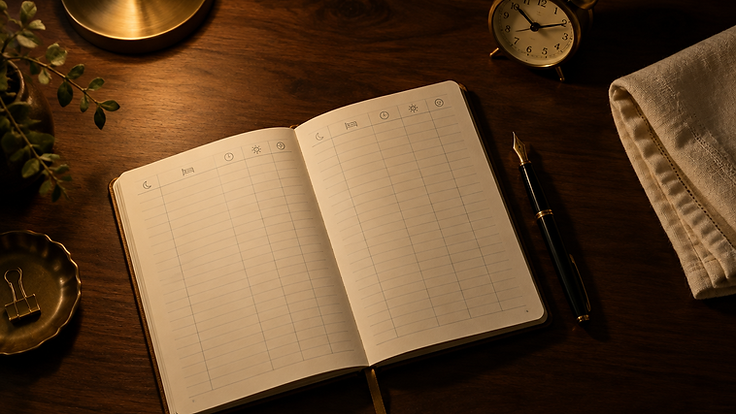
- Time you went to bed and the time you turned the light out — these are rarely the same.
- Roughly how long it took to fall asleep, estimated in fives.
- Night wakings: how many, and roughly how long you were awake.
- Final wake time and the time you got out of bed.
- One word for how you felt in the morning: rested, flat, tense, foggy.
Keep the wording plain
Write awake 40 minutes around 3am, not terrible night again. Judgements are hard to compare across two weeks; plain facts are not. Keep the same pen and the same page so the entries stay consistent.
Two weeks of ordinary entries tell you more than one perfectly remembered night.
A two-week routine
- Put the diary beside the bed, or the bookmark beside your phone.
- Fill it in within twenty minutes of waking, before the morning takes over.
- Leave it alone during the day — it is a record, not a scorecard.
- After fourteen entries, read the whole page at once instead of night by night.
Reading the pattern
Look for repetition rather than single bad nights. The table below is a starting point for a conversation, not a diagnosis.
| What the entries show | What it often suggests | A reasonable first step |
|---|---|---|
| Long time to fall asleep, stable wake time | Bedtime arriving before you are sleepy | Shift lights-out later by twenty minutes for a week |
| Several wakings, short awakenings | A busy or warm bedroom, or late caffeine | Note caffeine timing in the margin for one week |
| Long awake stretches in the early hours | Clock-watching and frustration building | Turn the clock away and write entries only in the morning |

Start with the printable version
If you would rather not draw the grid yourself, the free printable sleep diary uses exactly these fields and prints on a single sheet. When you have two weeks of entries, the sleep tracking guide explains what to do with them.
This article is educational and is not medical advice. If poor sleep persists for more than a few weeks, or you are worried about your health, speak to a clinician.
Free printable
Track this for two weeks with the sleep diary
A simple nightly worksheet — bedtime, wakings, morning energy — that often reveals a pattern memory alone misses.
Download the sleep diaryThis article is general education, not medical advice. It cannot diagnose or treat insomnia. If sleep problems are persistent or affecting your health, speak with a qualified healthcare professional. Read our medical disclaimer.
Written by
Editorial team